EU pay transparency: the job ad rules that start biting in 2026
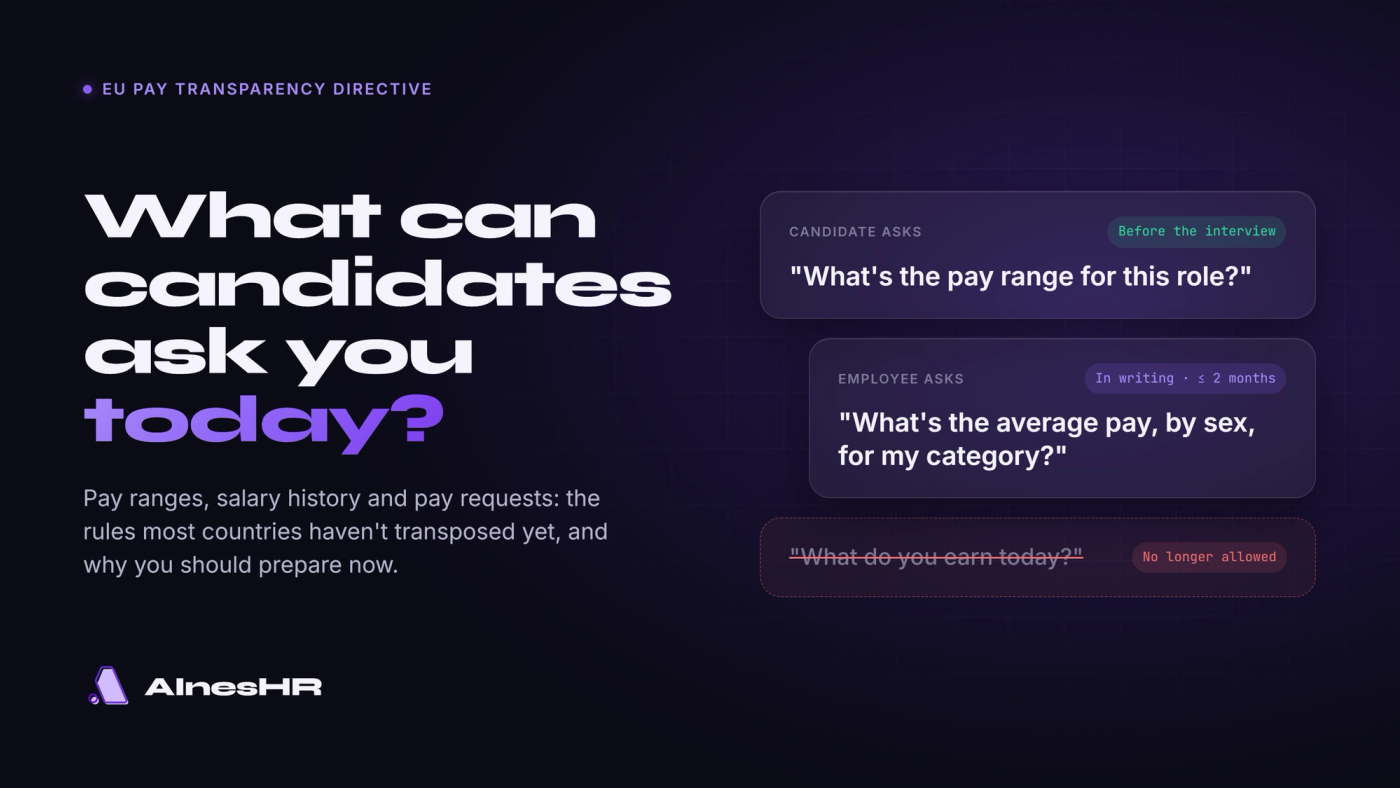
Candidates and employees can already ask you about pay, and in some countries you have to answer. Here is what changed in hiring and what to get ready this quarter.
What can candidates ask you today?
Quick question: do you know what a candidate can ask you today, before they even sit down for the interview? Or what an employee can ask about their pay, and what you have to say back?
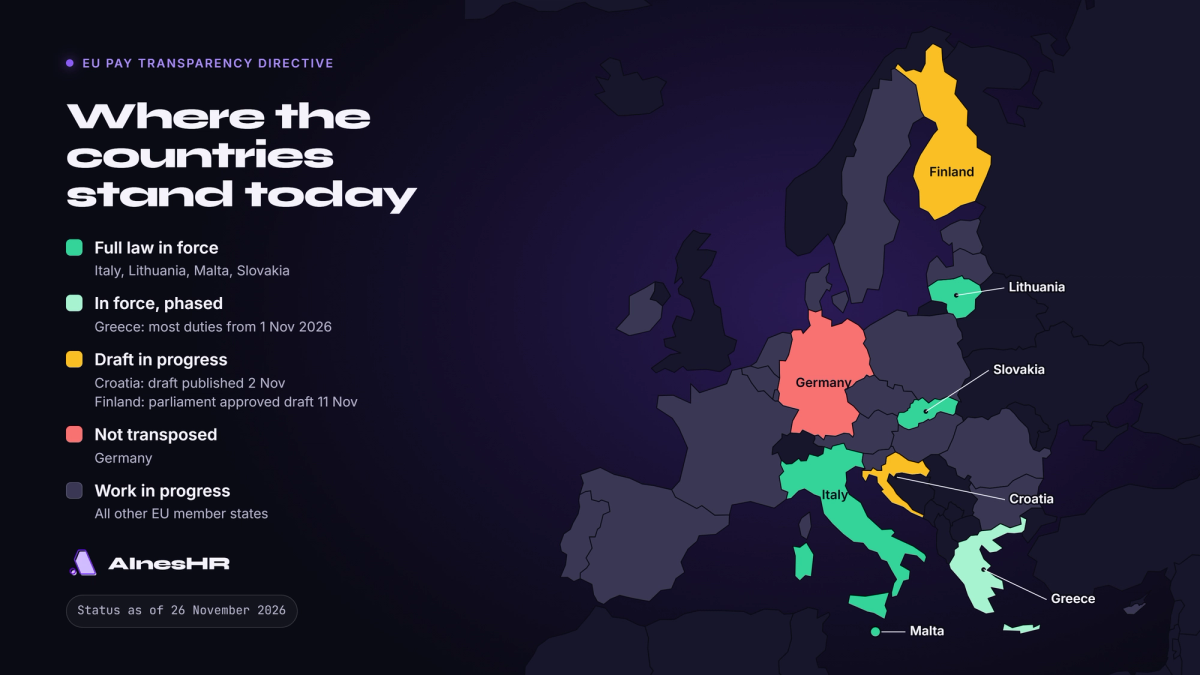
Europe set a deadline for these rules, and most countries missed it. A lot of companies heard that as extra time. I would read it differently. When the law lands, it lands fast, so I would get ready now.
Rule number one: show me the money (and stop asking about the old money)
The candidate sees the pay range before the interview. Not after, and not only if they ask. Be transparent and honest from the first moment. Putting the range in the job ad is the easiest way to do it, and it is also how you prove you did it.
The second half of this rule is where habits get tested: you can no longer ask candidates what they earn today, or what they earned before. You can ask what range they are targeting for their next role. For many recruiters and HR teams, asking about current salary is automatic. It lives in forms, scripts and checklists nobody has questioned in years.
So this is not only a legal change, it is a habit change. And habits change through education. Training recruiters and hiring managers, and building real literacy around fair pay and AI-supported hiring, will matter more than any memo.
Practical step: open your application form and your screening script today. If there is a question about current salary, delete it.
Rule number two: employees can ask, and "we will get back to you" is not an answer
Any worker can request their own pay level, and also the average pay, split by sex, for people doing the same work or work of equal value. You have to answer in writing, within two months.
Here is the question I would ask you: if an employee asked today, could you say who sits in the same category as them? Most companies cannot, and that is the real problem. The law is not hard. The grouping is.
A percentage with no visible calculation behind it is not an answer, not for an employee, not for a works council, not for an inspector.
So before the request arrives, decide who drafts the answer, who signs it, and how you show the calculation.
Plot twist: this is the part your CFO will care about
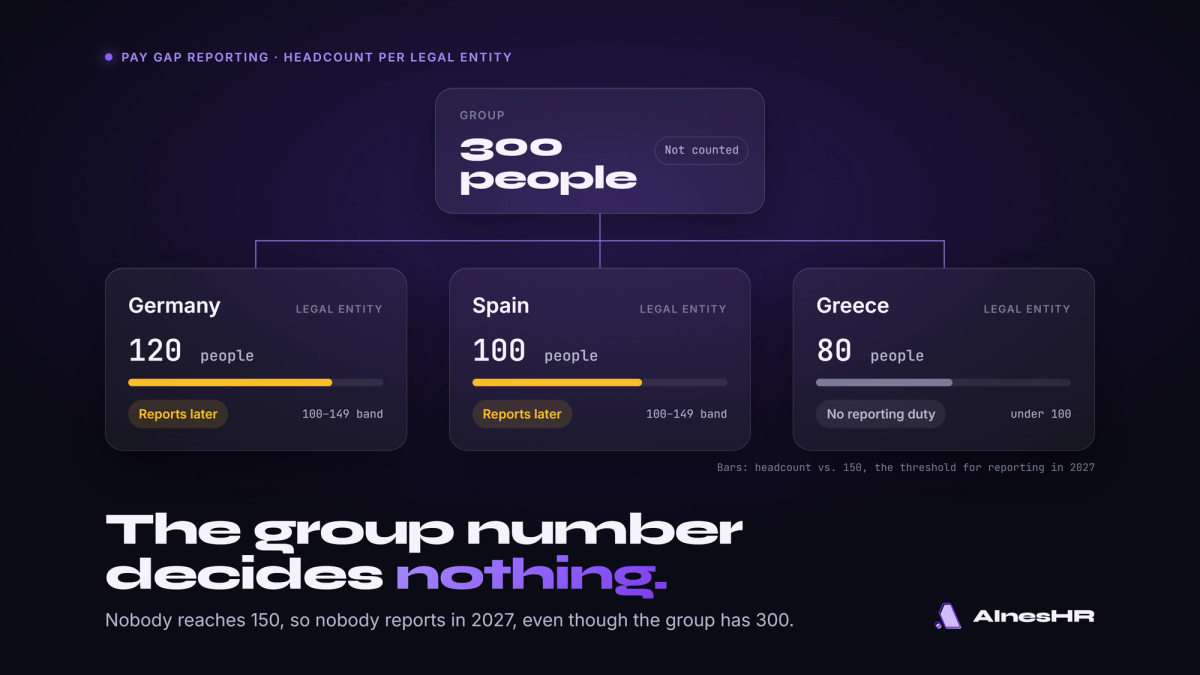
If your company has 150 or more employees, your first pay gap report is due in June 2027, and it covers 2026 pay. That means the salaries you are paying right now are already under the magnifying glass. Smaller companies, from 100 employees, report later, on a longer timeline.
Here is where people get confused. The headcount is counted per legal entity, not for the group. Imagine a company with 300 people in total: 120 in Germany, 100 in Spain and 80 in Greece. Each country has its own legal entity, so the group number does not decide anything. What matters is the count in each one, and each country also follows its own national law and timeline.
Then there is the five percent rule. If the pay gap between women and men in a job category is five percent or more, you cannot justify it with objective, gender neutral reasons, and you do not fix it within six months, you must run a joint pay assessment with employee representatives.
So "are we compliant?" becomes a number, per country, per entity, per category. And it only works if your categories are right.
Your homework for this quarter
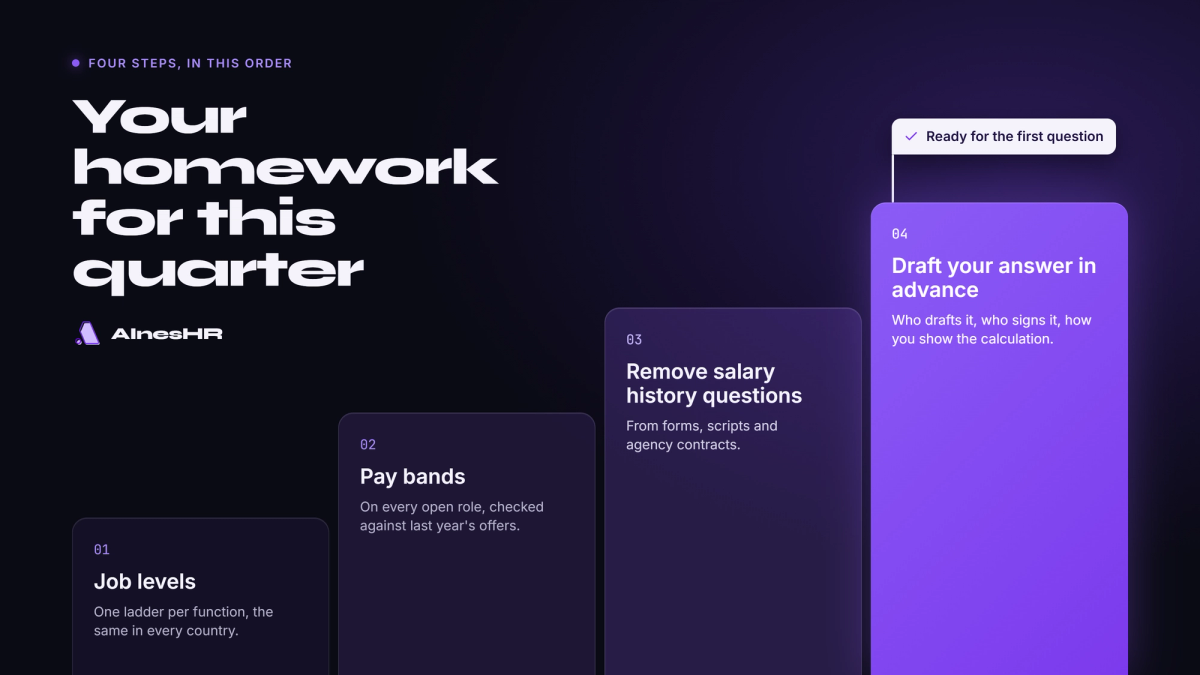
Four things, in this order.
- Build your job levels before your pay bands. One ladder per function, the same in every country, so that a senior accountant in Germany and a senior accountant in Spain can be compared, or deliberately not.
- Put a pay band on every open role and every role about to open. Then check those bands against the offers you made in the last twelve months. If reality and the band disagree, fix the band, not the record.
- Remove salary history questions from your forms, scripts and agency contracts, country by country, and give recruiters a script that asks about target range instead.
- Write the answer to a pay information request before you receive one. Who drafts it, who signs it, how you group people, how you show the calculation.
In my experience, the legal text is not the hard part. Having categories, bands and numbers that survive a question is.
So, back to where we started: do you know what a candidate can ask you today, before the interview? Or what an employee can ask about their pay? If the answer is not a confident yes, you already know where to begin. Open your job ad template this week and check that the pay range is there.
Frequently asked questions
We are 80 people. Does this apply to us?
Can we ask for salary expectations?
Do we have to put the range in the ad, or can we tell the candidate later?
Does a very broad range count?
Does this apply in Switzerland and the UK?
What happens if we are not ready?
Sources
- 1.Directive (EU) 2023/970 on pay transparency, full text, EUR-Lex, Official Journal of the European Union
- 2.Summary of Directive (EU) 2023/970: equal pay for equal work or work of equal value, EUR-Lex
- 3.New EU rules on pay transparency explained, European Commission
- 4.Frequently asked questions on the Pay Transparency Directive (2023/970), European Commission
- 5.EU action for equal pay, European Commission
- 6.Pay transparency in the EU, Council of the European Union

Written by
Ana Inés Urrutia
Founder & CEO, AInesHR
Ana Inés Urrutia is the founder of AInesHR and an HR consultant who helps European companies stay compliant across multiple countries, from GDPR to the EU AI Act and pay transparency.
More from Ana